
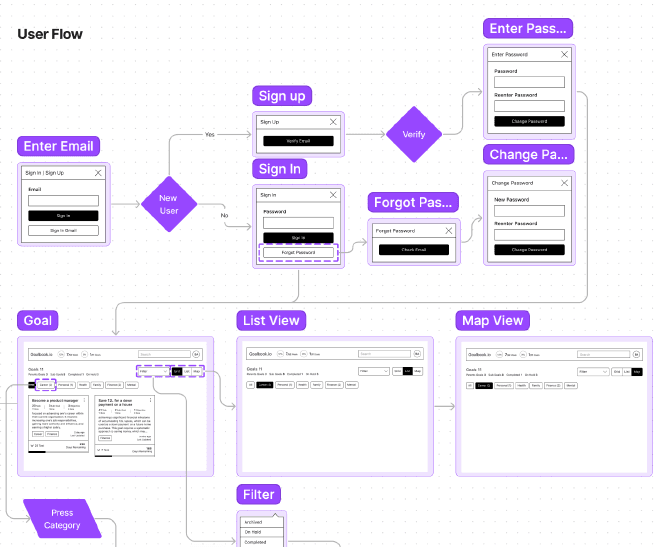
While working on goalbook.io, a productivity application, I hired a freelancer for design collaboration. After conducting user research with eight participants from varied backgrounds, the team planned to develop interactive prototypes for further testing.
The Communication Challenge
Initial communication challenges arose when sketches alone failed to convey the design vision. I attempted using cut-out cards to demonstrate screen interactions, but found this approach time-consuming and unclear.
The breakthrough came through FigJam, where actual screens were arranged to show interaction flows on a single canvas. This visualisation method proved significantly more effective for collaboration, allowing the freelancer to understand connections between screens and create accurate prototypes.
Why Screen Flow Diagrams Work
Screen flow diagrams turned out to be a real game-changer for communicating ideas and collaborative efficiency. Unlike traditional prototypes, these diagrams excel at displaying conditional paths and complex navigation patterns simultaneously.
With a traditional Figma prototype, you can only see one path at a time — you click through screens in sequence. A screen flow diagram shows the entire landscape at once: every screen, every decision point, every edge case on a single canvas.
This is especially valuable when:
- Communicating with developers who need to understand all the conditions and states
- Reviewing designs with stakeholders who want to see the big picture
- Onboarding new team members to complex flows
- Documenting edge cases that would require dozens of prototype screens to replicate
Screen flow diagrams outperform traditional prototypes for conveying complex interaction patterns and enabling efficient team collaboration without ambiguity.
